Pacific’s School of Medicine: What We Know So Far
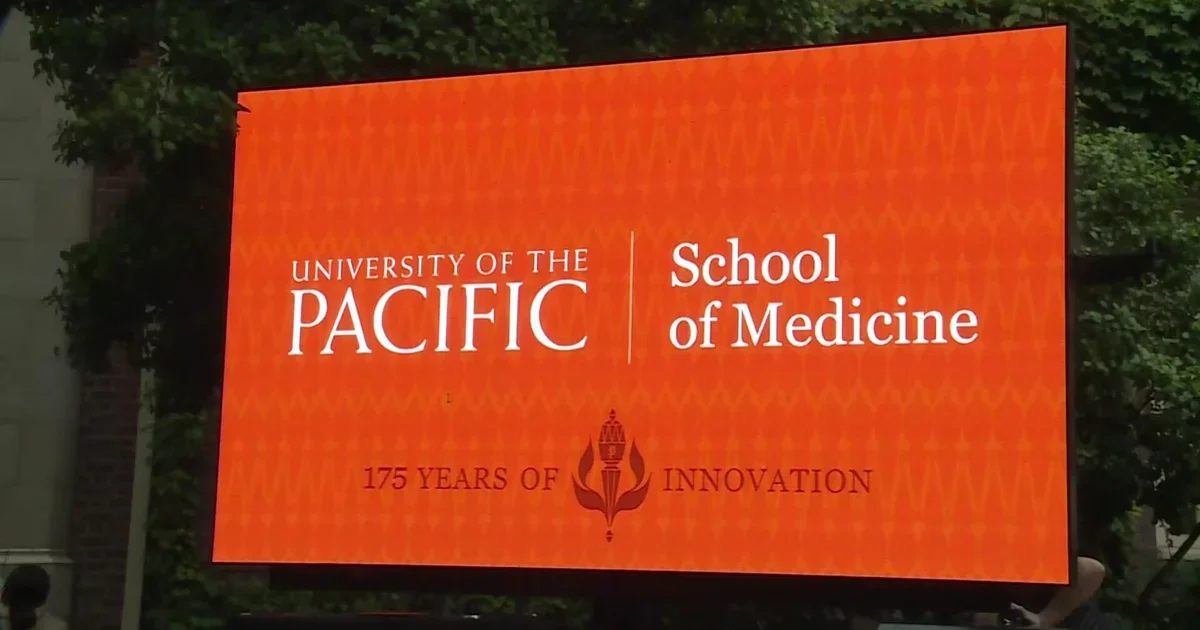
Photo by CBS News
Pacific moves closer to bringing a new medical school to the Central Valley
Pacific’s Stockton campus may look very different by the end of the decade, with hundreds of future physicians joining its student body.
This past May, University of the Pacific made official plans for a new School of Medicine on its Stockton campus. The announcement came days after the University’s Board of Regents approved the school in an attempt to address the physician shortage not only in Stockton, but throughout much of California’s Central Valley, after more than a year of exploring its feasibility.
Since then, the University has been fast at work preparing for its opening in fall of 2030. In just four months, the University has already secured a clinical partnership with Dignity Health St. Joseph’s Medical Center in Stockton, and has begun developing the school’s curriculum and started preparing for accreditation.
Dignity Health St. Joseph’s Medical Center, the largest medical center in San Joaquin County and ranked in the top 5% in the nation by Healthgrades, will provide third- and fourth-year Pacific School of Medicine students with clinical learning opportunities. Pacific President Christopher Callahan has described this collaboration as “the perfect partnership.” David Ziolkowski, president and CEO of St. Joseph’s Medical Center, similarly described the two institutions as being “ideally aligned” in their effort to address the physician shortage across the region.
Currently, California’s existing Doctor of Medicine (M.D.)-granting schools remain concentrated in the Greater Sacramento area, the Bay Area, and Southern California, making Pacific’s planned school the state’s first M.D.-granting institution outside these major population centers.
Next on the agenda: finding the school’s new founding dean. The hope is for the dean to assume their role as soon as 2027, after which further preliminary accreditation and building design can take place in 2028. Then, in 2029, construction and recruitment of the school’s first class will begin, bringing this multiyear project one step closer to reality.
In total, the project is expected to cost approximately $150 million and will include a 100,000-square-foot medical education complex, simulation laboratories, and specialized equipment. As of September, Pacific has reported securing more than $30 million in private donations, $2 million in state funding, and plans to commit another $50 million in university resources.
Still, University of the Pacific’s School of Medicine couldn’t be coming at a better time.
According to the California Health Care Foundation’s 2026 San Joaquin Valley Regional Market Report, the five-county area examined in the report is facing significant shortages in its physician workforce. Specifically, the region has only approximately 217 physicians per 100,000 residents compared to the statewide ratio of 358 per 100,000. This means that the region has only about 61% of the statewide physician supply per capita.
The shortage extends beyond just primary care. In fact, it affects specialties including cardiology, dermatology, neurology, obstetrics and gynecology, pediatrics, psychiatry, rheumatology, and gastroenterology. This leaves some residents from the Central Valley having to travel to larger metropolitan areas such as Sacramento or even Los Angeles for treatment when certain specialties are unavailable locally.
The hope is that educating physicians within the Central Valley will help build a pipeline of doctors who not only understand the care needed within the region, but ultimately make the decision to remain there to practice too. This idea aligns with broader physician-retention trends. Per the Association of American Medical Colleges, approximately 75.7% of physicians who completed residency training in California between 2015 and 2024 proceeded to practice within the state, making it the highest retention rate in the nation.
To do this, Pacific has said that it plans to build upon its existing health care programs in addition to creating pathways from undergraduate pre-med programs. Though, the University has yet to announce details about how exactly these pathways will work.
Nonetheless, this is nothing foreign to the University, as it already trains students in several different health professions through the Arthur A. Dugoni School of Dentistry, Thomas J. Long School of Pharmacy, and School of Health Sciences. Pacific plans to gradually grow the School of Medicine to approximately 400 students by 2037. With this addition, Pacific will become just the 36th university in the country to have schools of medicine, dentistry, pharmacy and health sciences.
Not only will the School of Medicine expand health and educational opportunities for Stockton and the surrounding areas, but Pacific also intends for it to have a positive economic impact. An estimate by Pacific’s Center for Business and Policy Research reports that the school could generate more than $1.3 billion in regional economic output during its first decade after opening.
But for now, several major steps still remain before the school’s first class of medical students arrives on the Stockton campus. Pacific must still select its founding dean, secure additional funding, construct the new medical education complex, and complete the accreditation process.
If everything goes according to schedule, construction will begin in 2029 and Pacific will welcome its inaugural class in fall 2030.