
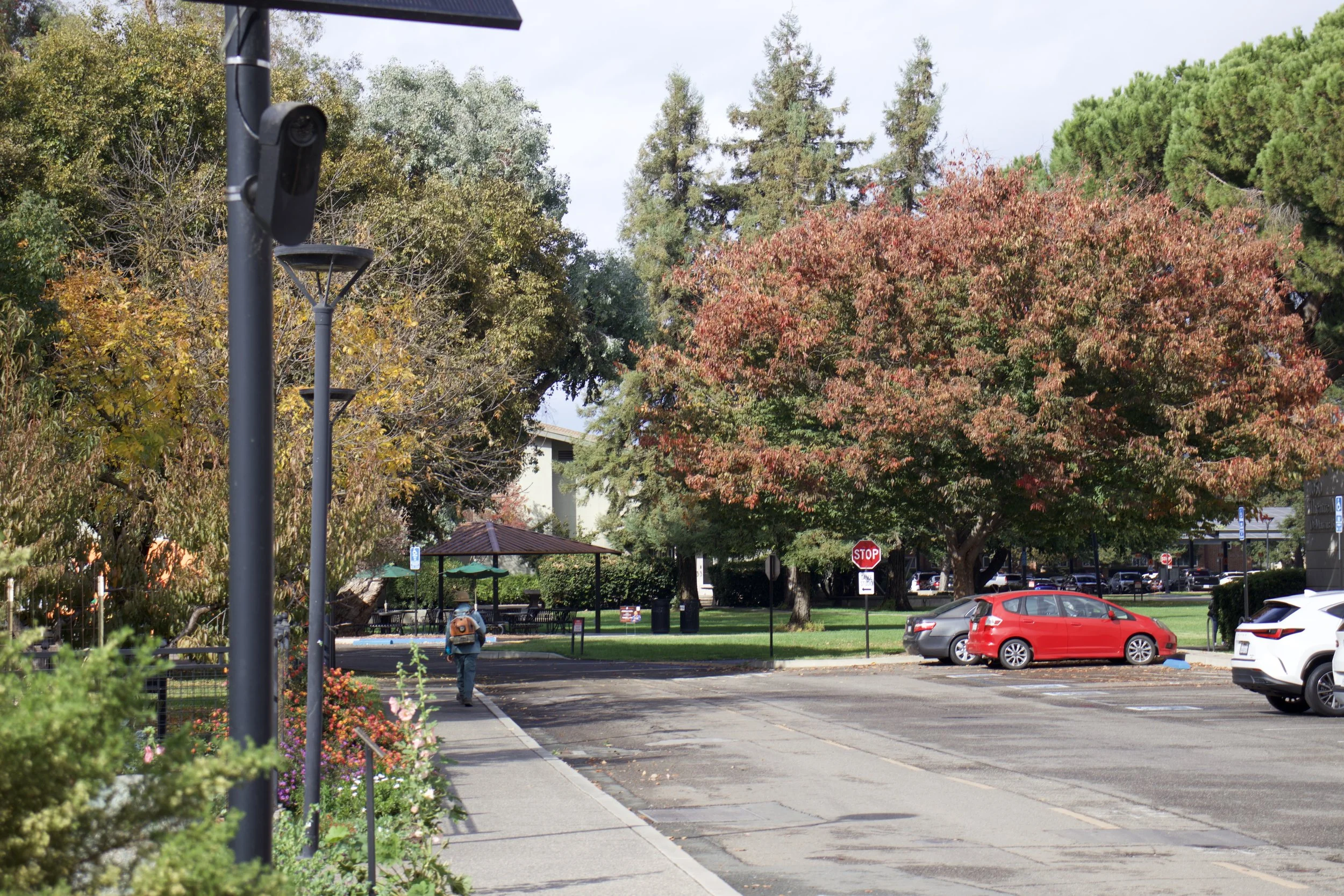
How UOP students feel about the presence of Flock cameras
For the past several years, the University of The Pacific campus has been widely regarded one of the safest areas in Stockton, with an emergency response line on every corner, and security camera at every turn. That changed over the summer, when students traveling around Robb Garden would notice the presence of something highly disturbing: a Flock camera facing the street. What sets these cameras apart from the typical university security cameras? These cameras, and the data inside them, are owned by Flock Safety, a private, government-contracted organization, not the University.
At first glance, the camera might not seem like much to worry about. It is a small device mounted on a pole, quietly observing passing traffic. Unlike a traditional security camera, however, Flock cameras use automated license plate recognition technology to capture and analyze the license plates of passing vehicles. Depending on the system and its configuration, the technology can also record vehicle characteristics, such as color, make, and model. This information can then be used to search for vehicles associated with investigations.
The technology raises an important question for Pacific students: How much privacy should we be expected to give up in exchange for security?
There is no denying that campus safety is a legitimate concern. Stockton has experienced its share of crime, and technologies that help police locate stolen vehicles or identify cars connected to serious offenses can serve a useful purpose. For students, faculty, staff, and visitors who walk across campus late at night, the knowledge that law enforcement has additional tools to investigate crimes may offer some reassurance.
However, the benefits of surveillance should not exempt it from scrutiny. The concern is not simply that a camera exists, but that the information it collects may be stored, searched, and shared beyond the immediate location where it was captured. A camera that records a license plate can potentially create a record of when and where a vehicle was seen. When enough cameras collect this information over time, those records can help reveal patterns of movement and association.
For a university campus, that possibility deserves serious consideration. Pacific is not merely a place where people attend classes. It is where students socialize, participate in clubs, attend events, visit friends, and build their lives outside the classroom. Students should be able to move through these spaces without feeling that their everyday activities are being systematically documented by an organization they know little about.
This is particularly concerning when students may not know who controls the cameras, how long information is retained, or who can access it. If a camera is installed on a public street near campus, its presence may be entirely legal. But legality alone does not answer whether its use is appropriate, transparent, or consistent with the expectations of the University community.
Flock Safety's involvement also complicates the issue. Because the company supplies surveillance technology to law enforcement and other customers, questions about data access and sharing become central to the conversation. Who can search the information collected near Pacific? Can other agencies access it? What safeguards prevent misuse? And what happens when information collected for one purpose is later used for another?
These are not arguments that every Flock camera will be misused. Rather, they are questions that deserve clear answers before students are expected to accept this technology as a normal part of campus life.
The University also has a responsibility to communicate with its students. If the cameras were installed as part of a partnership involving local law enforcement or another public agency, students deserve to know who authorized their placement and what agreements govern their use. If Pacific has no direct control over the cameras, that distinction should be made equally clear. Students should not have to rely on speculation or word of mouth to understand the surveillance infrastructure surrounding their campus.
Transparency would be a reasonable starting point. The University and the relevant agencies should publicly explain the cameras' purpose, ownership, data-retention policies, access restrictions, and procedures for investigating complaints about misuse. Students should also have an opportunity to express their concerns and ask questions before additional surveillance infrastructure is introduced near campus.
Ultimately, this debate is not about choosing between student safety and student privacy as though only one can exist. A university can support legitimate crime prevention while demanding safeguards against unnecessary or excessive surveillance. Clear policies, limited data access, meaningful oversight, and public accountability can help ensure that security technology serves the community rather than undermining its trust.
Pacific students should not have to oppose campus safety to question the tools being used in its name. Wanting safer streets and wanting personal privacy are not contradictory positions. Both are essential to a campus where students can feel secure, respected, and free to live their lives.
A Flock camera may look like an ordinary piece of equipment on a street corner, but the questions surrounding it are much bigger than the device itself. As surveillance technology becomes increasingly common, Pacific has an opportunity to demonstrate that safety initiatives should be accompanied by transparency and accountability.
Pacific is not the only Stockton college facing questions about Flock Safety. In September 2026, The Collegian, San Joaquin Delta College's student newspaper, reported that Delta had installed three Flock cameras across its campuses, following a $9,000 expenditure in 2025. The report also examined growing concerns over privacy, alleged misuse, and the monitoring capabilities of the technology.
Those concerns extend beyond college campuses. In September, Stockton police disclosed that an internal audit had identified potential misuse of the city's Flock camera system, prompting an investigation and the termination of an employee. These incidents illustrate why the debate surrounding Flock cameras cannot be reduced to whether surveillance helps solve crimes. It must also address who can access the information, how that access is monitored, and what consequences exist when the system is misused.
For Pacific students, the experience at Delta offers a reason to ask questions now rather than after concerns emerge. Who authorized the cameras near campus? What policies govern the information they collect? And what safeguards are in place to protect students and other members of the community?
The question is not whether Pacific should care about safety. It is whether the community should be expected to accept surveillance without first being told how it works, who controls it, and what protections exist for the people it observes.