
Photo From University of the Pacific
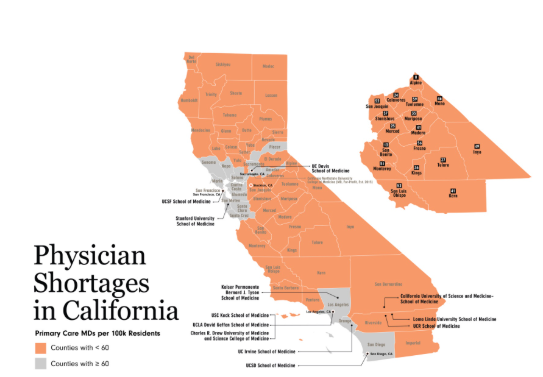
“South of Sacramento and the Bay Area, and north of Los Angeles, there is not a single county that is even reaching the bare minimum of physicians per capita, and there is not one MD-granting school. The need is dramatic, and growing.” — President Cristopher Callahan
“You never cut your way to success, you grow your way to success.” - President Cristopher Callahan
If you are anything like me (a curious economics student), the announcement of Pacific’s new School of Medicine, while exciting, raised a few questions. Namely, how would the University fund this massive investment? And who would that cost fall upon? How would that investment affect the students who are here now, and those who will be in the coming years?
My initial reaction, to put it plainly, was negative. I came from a place that cut liberal arts programs out of a liberal arts school, while taking on debt to invest in the larger programs that drive most of the revenue. This issue is not unique to my small, former college in New York, as it seems to be spanning higher education across the country. The reallocation of resources away from programs whose value is not in the revenue it brings, is what scared me.
So, I did what any logical person would do. I asked the president of the University, Christopher Callahan, for an interview. Much to my surprise, he accepted.
A few weeks later, we sat down at his office in Anderson Hall to talk about the School of Medicine. Before we began, he asked me about myself — what I was studying, and what I was looking to do after graduation. I did not expect him to be as down-to-earth as he was.
I began the interview by asking about the journey from proposal to announcement to where we are today. It was no surprise to learn that a school of medicine has long been in discussion within the Pacific Administration.
“Ironically, [Pacific] had the first school of medicine in the state of California… known today as the Stanford School of Medicine,” The President begins.
“As we understand it, there is a great need for physicians, especially in this region.” Callahan continues, “So we hired a consulting firm, and our questions were: Do we have the expertise to do this? How much money do I need to raise to build a new building, equip the building, and cover operating costs for 10 years? Basically, give us a feasibility study, which they did, and they were like, ‘Yeah, you can do this.’”
I then asked about funding for the school.
He sat quietly for a few moments before going on to tell me that the 50 million dollars the board approved is coming in the form of a construction bond on the actual building to be built for the school. As for the private donations, the current estimate was about 45 million, bringing the total to about 95 million.
“There’s still a lot of work to do, but we’re in a lot of conversations. It’s not that fundraising that kind of money is easy, but the case is so compelling. And there are so many people who live in the central valley who understand the need for more physicians.”
I asked him about the contingency plan. What would happen if the fundraising came short or if costs exceeded the estimates?
“We don’t fail,” he says, before apologizing for the unintended flippancy.
He goes on to say that this question is the reason why they spent so much time on the feasibility study. The announcement did not come until the plan was far enough along and (they had gained enough funding) they were entirely confident that it would work.
I asked how the University is ensuring that the investment in the School of Medicine does not come at the expense of the students within the rest of the institution.
The President quickly answered, “Number one: it’s a completely separate financial model.”
The school’s financial framework is designed to operate separately from the rest of the University and be self-sustaining. No current University money is going into the School of Medicine. The 50 million dollar construction bond will be paid back by the revenue from the School of Medicine itself as it begins to operate and grow.
“As the economics of higher education have become more problematic… it becomes more imperative that you need to be financially healthy going forward,” he said.
1. The Pacifican reported in early October that about 80 million dollars had been secured (with an estimated total cost of 150 million), 50 million of which was coming from UOP itself.This financially independent model is essential with the economic landscape of higher education, and medical schools themselves are extremely expensive. The construction bond has not gone to market yet, as the construction of the new building will not begin for another few years, but it will allow current University funds to stay serving students where they are.
He compared the med-school model to the School of Health Sciences, the most recent new program introduced at Pacific, which was implemented without a fundraising campaign and became part of the overarching financial design of the University. He admits it worked out fine, but because medical schools are so expensive, this project required a more intentional plan. Ensuring that the school of medicine would not negatively impact the rest of the University and its students was a necessity, if the plan was to become a reality.
I asked about the new building that will be built on the Stockton campus. He remarked that people have often asked him why the school is not going to be put on the San Francisco or the Sacramento campus. He said plainly, “That’s not where the need is.”
“Come here for a second, Tyler” — we got up and walked across the room to a TV with an orange and grey map of California. The grey counties meet the minimum physicians per capita, the orange representing counties with shortages. The orange stretches from south of Sacramento all the way to Los Angeles county. “To me, this is why we are doing this,” he says.
The Central Valley’s lack of a MD-granting institution has meant that those who are from the Central Valley, have had to leave it in order to become a doctor. This fact, coupled with the tendency doctors have to practice near where they get their MD, has created a more difficult path for doctors who are from here, to practice here. Pacific’s School of Medicine aims to change that, creating a steady flow of new, largely homegrown doctors.
2. The UC Davis School of Medicine is in Sacramento, UCSF and Stanford’s medical schools are in the San Francisco area. Santa Clara University is currently building the new Mark & Mary Stevens School of Medicine on the Sutter Health campus in Santa Clara. The greater Central Valley does not have an MD-granting institution between Sacramento and Los Angeles county. 3. According to the American Board of Family Medicine, over half of doctors practice within 100 miles of their MD program, and about 25% practice within five miles. He said the question now is if there is a model where the medical prerequisite programs like biology and chemistry could benefit from the new building and resources too. He mentioned that this possibility is in early development, but that it could be a great opportunity to expand these undergraduate programs.
The ultimate plan is to create a pre-med track (similar to existing pre-pharm, pre-dent, and pre-law tracks) where students can come to Pacific for their undergraduate, fulfill certain requirements, and stay for their professional schooling, in this case their Medical Doctorate.
Near the end of our time I asked how we can measure the success of the medical school as it begins to operate. “If we have a class of 100 students, and 5 wind up practicing in the Central Valley, we fail.”
I must agree with President Callahan, and I am happy to. If kids who are from the Central Valley are able to stay in, study in, and serve the communities that they come from, that sounds like success to me. Especially, if it is not coming at the cost of other parts of the University, at a time when it would be easy to make cuts to academic programs in order to fund the bigger, revenue drivers. I went in skeptical, but I left confident in the mission, the plan, and I think in the man in charge, too. I am excited to follow along as Pacific moves closer to its first class of homegrown physicians.
Sources:
https://www.pacific.edu/pacific-newsroom/state-providing-seed-money-new-pacific-school-medicine
https://www.kcra.com/article/university-of-the-pacific-plans-new-medical-school/71433919