
The 363° Code: Tesla’s Geometry, Isis’ Breath, and the Return of Osiris
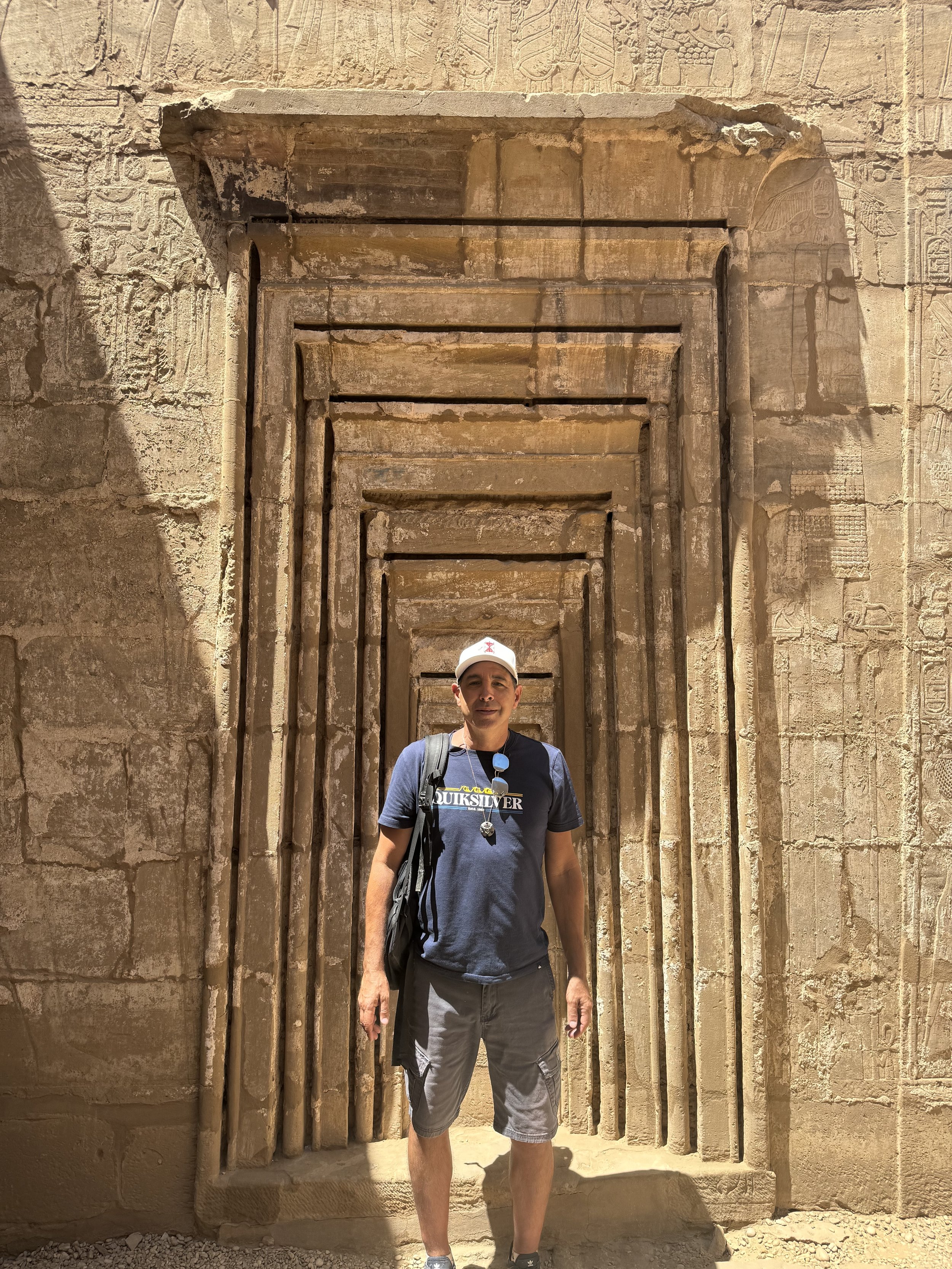
Photo by Ria Bansal
Dr. Vierra’s newly published book!
Groundbreaking research is unfolding right here at Pacific, where a decades-long project on black widow spider silk has expanded into an ambitious, interdisciplinary exploration of geometry, biology, and ancient symbolism. Dr. Craig Vierra’s lab work began in 1998 with a focus on the molecular mechanics of spider silk, but everything changed about three years ago when he became fascinated by the red hourglass marking on the black widow.
Although the hourglass is commonly understood as a warning signal for predators, like birds. Dr. Vierra argues that its significance goes deeper—especially since related species do not share the marking. He proposes that the hourglass shape encodes the breath cycle of the universe: magnetic waves radiating outward in centrifugal expansion and dielectric waves returning inward in centripetal contraction, forming nested shells, wave formations, and even ancient artistic geometries. This curiosity led him to new questions, new fieldwork, and ultimately a new book, The 363° Code, published just a few weeks ago.
According to Dr. Vierra, his work suggests that nature contains an “etheric lattice”—an invisible geometric framework that vibrates according to precise harmonic ratios. He argues that these same ratios appear in Egyptian hieroglyphs, temple layouts, and cosmological diagrams. In May 2024, he traveled to Egypt to study the Sphinx and other ancient structures, claiming he can now read ancient Egyptian hieroglyphics—specifically the well-known “Weighing of the Heart,” glyph—where numerology, color patterns, and structural motifs encode scalar physics and biology rather than symbolic storytelling alone.
His theory extends to Nikola Tesla who Dr. Vierra stated to be “the greatest scientist on the planet.” Tesla’s famous fascination with the numbers 3, 6, and 9, is what Dr. Vierra describes as a rhythmic breathing cycle of the universe. “If you understand the key to the 3-6-9 code, you have the key to the universe,” he says. He even proposes that in higher-dimensional geometry, a circle is not 360 degrees, but 363 degrees—a concept he says unlocks new ways of understanding resonance and structure. His journeys continued through Italy in August 2025, where he examined Leonardo da Vinci’s work, including The Last Supper, through this geometric lens.
Dr. Vierra believes these discoveries could eventually influence sustainable materials, communication technologies, transportation innovation, and non-invasive medicine. He argues that ancient civilizations, particularly the Egyptians, once used harmonic mathematics to tune their stone structures, drawing energy via resonance from the etheric lattice much like biological systems do. These ideas have energized the lab’s mission to combine molecular genetics, biomaterials engineering, music, mathematics, and scalar-field physics. Dr. Vierra is also preparing to share these ideas more broadly through upcoming podcasts in the new year.
“For Pacific students, the excitement lies in the opportunity to engage directly with research that blends laboratory science, geometry, history, and bold theoretical innovation. This is not simply a study of spider silk—it is an attempt to decode what the researchers see as the hidden mathematics of nature and the energetic architecture of the universe.” Students have the chance to work alongside faculty exploring everything from silk mechanics to ancient temples, from harmonic sound patterns to geometric shells connected to higher-dimensional planes.
Intended to make complex ideas accessible to a broader audience, The 363° Code serves as both a summary of Dr. Vierra’s claims and an invitation for readers to explore how mathematics, biology, and culture may be intertwined in unexpected ways.